

Transcripts
DR. BRANDT:
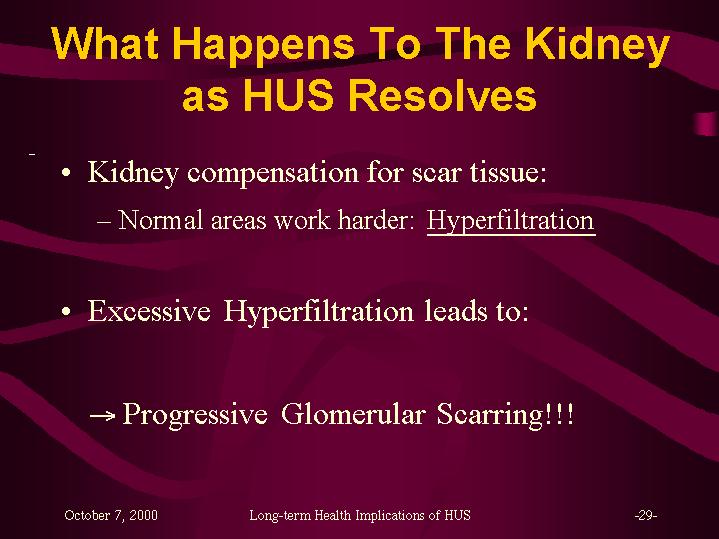
Now, the kidneys will compensate for scar tissue formation. Normal areas will tend to work harder to make up for the damaged ones. The undamaged glomeruli increase their single nephron GFR so that each glomeruli is doing a little bit more work to keep the total glomerular filtration rate near normal. This process is called hyperfiltration. This works quite well for a while but there's a big problem with hyperfiltration. The hyperfiltration of the
glomerulus tends to lead to low grade inflammation in the glomerulus. That inflammation can then lead to progressive glomerular scarring even in those glomeruli that are completely recovered or were unaffected by the HUS.
So if a child has enough injury and gets enough filtration, the child ends up in a catch-22 situation in which you can have progressive injury independent of the HUS.
The HUS is gone, it's resolved. But if you've got enough injury you're going to set up a condition where injury is going to increase over the years.
And at what point there is enough scar formation to lead to significant hyperfiltration is something that is very difficult to get at and very frustrating for a nephrologist because it's hard to tell people when they've had enough injury that they're likely to have more injury.
