

Transcripts
DR. MAUSETH:
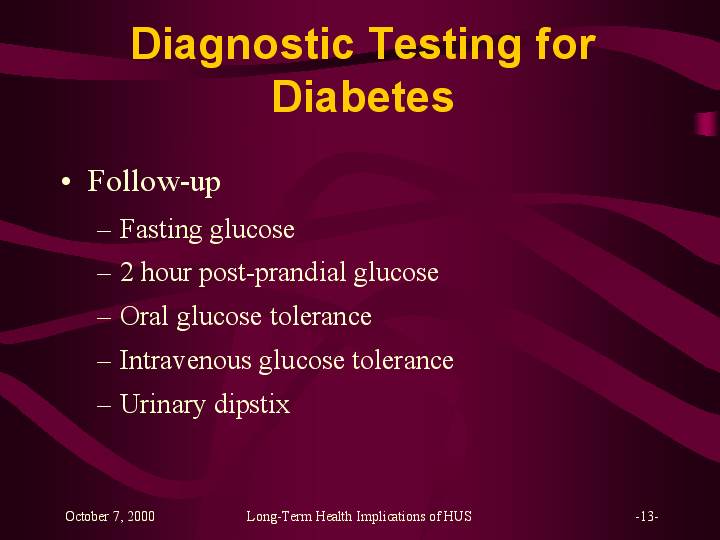
We did oral glucose tolerance
tests on a lot of the patients, oral glucose
tolerance in Jeff Brandt's follow-up study. Many
of these are somewhat difficult to do. They're
not tremendously hard, but I think that if you
found an abnormal glucose tolerance test you
would be somewhat concerned. But the question
would be would you treat them with anything.
So as far as a parent wondering
if they're going to change something with their
child's medical care I think the bottom one here
is probably easiest. Parents would look at this
and say, okay, when should I be doing something
about the possibility of glucose intolerance.
And that's usually when you're having a blood
sugar over about 175.
And sugar starts showing up in
the urine at about 175. And that can be done
by a simple test looking at your -- collecting
the sample of urine or having a child urinate on
a dipstick, which can be bought over the counter
at stores. And I would do this in periods of
stress, periods of illness, or anytime someone
felt like they were having symptoms.
But, again, even though you
haven't had diabetes in -- in the period of the
acute illness, I wouldn't discount it later on
as being a possibility.
Diabetes is not a frequent thing
with HUS, but it can be significant. Again,
I would warn you that you really want to be
aware that as kids grow, kids gain weight and
that kind of thing, they can change. And that's
one of the problems with the studies that have
been done is we really don't know where these
kids are going to end up when they're 30, 40,
50 years old.
