

Transcripts
DR. LINGWOOD:
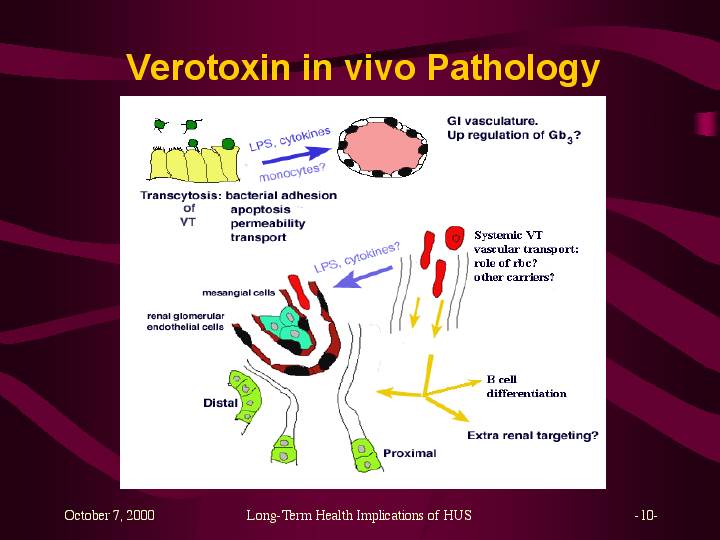
This is a schematic of the
major routing of the toxin that results in
pathology. The binding of the organism to the
GI tract to the mucosal cells here, the transit
of the toxin through this by some as yet unknown
mechanism. And these are the risk factors of
that transit -- LPS and cytokines produced by
monocytes can stimulate Gb3 in the GI vasculature
locally at the site of attachment, but then via
systemic VT transport in the circulation.
Here we come across the roll of
red blood cells. Red blood cells contain Gb3
but in my lab if you add red cells to verotoxin
they just ignore it. These cells have Gb3 but
they don't bind VT. Why is that? Are there
any other carriers? And some researchers in
Holland have suggested that monocytes, these
monocytes can produce cytokines following VT
exposure that actually can carry the toxin in the
blood, as well as, internalize. They are VT
resistant and they might target the toxin to the
glomerulus because monocytes accumulate at the
renal lesions in HUS.
They've also recently published
that chemical species that attract monocytes are
elevated in the urine of HUS patients. So
that's another feasible route -- another kind of
carrier that brings the toxin to the renal site,
here -- these mesangial cells, they actually have
the receptor but they are not killed, VT
prevents the growth. Glomerular endothelial
cells are the primary target - inducing fibrin
occlusion of the capillaries. Renal tubular
epithelial cells are quite VT sensitive, but this
could be increased by LPS.
Also, in the kidney targeting in
the distal tubule particularly in the region
where it comes back to the glomerulus, this is
so-called juxtanuclear complex and also some
proximal tubules are targeted so reabsorption is
compromised. And then there's extra renal
targeting - for example is there Gb3 expressed
in the pancreas? Also, in the brain are
there different Gb3 isoforms? The effect on B cell
differentiation.
In the last little while I just
want to say that there are some positive aspects
to the verotoxin.
