

Transcripts
DR. BRANDT:
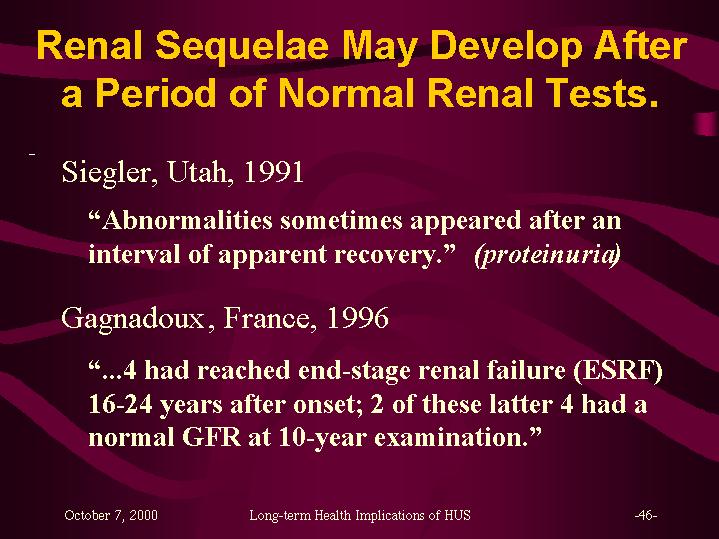
Of particular concern is the finding that sometimes children would have normal studies at follow-up and then on repeat follow-up years later sometimes they would have abnormalities.
Dr. Siegler in Utah found that sometimes proteinuria would not be present in a patient and then in later years it would be present. And since proteinuria is probably a marker of hyperfiltration in these patients, it probably indicates progressive injury due to hyperfiltration.
In France in 1996, a very large, long-term study found that four patients had reached end stage renal failure around 20 years or so after HUS and that two of these latter four had a normal GFR at their 10 year examination.
So these are concerning because I think it's difficult for us, based on this, to say to a family, "You're completely out of the woods." I just don't think we know enough to be able to predict who will have problems later on and who doesn't.
Certainly, as Dr. Mauseth mentioned this morning, probably the longer you do better, the longer you're going to do better. So if at three and five and seven years you look great, no evidence of urine or GFR, the chances get lower and lower and lower that you're going to have any problems. But I don't think we can say that you have a zero chance of having no problems.
